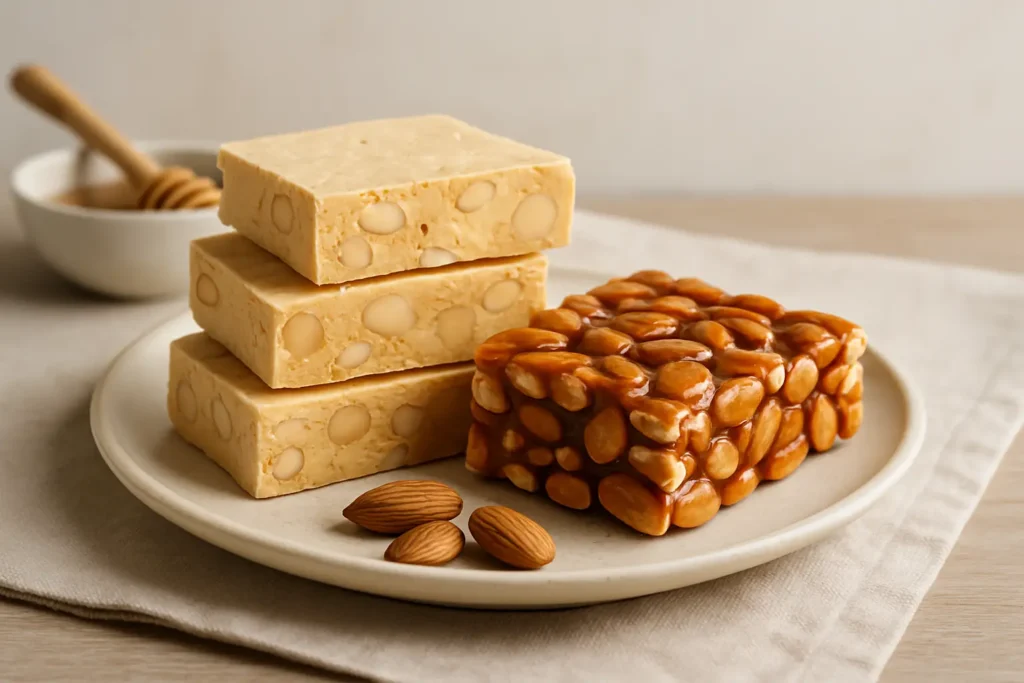
It is often seen in December, tucked into a gift box or placed at the center of a festive table. However, turron is not a simple “Spanish nougat” to be nibbled on distractedly. It is a confection with character, made to be tasted, discussed, shared—and sometimes compared, as styles vary so much.
What is Spanish turron?
Spanish turron is a traditional confection made from almonds and honey, linked to ancient craftsmanship and a festive culture deeply rooted in Spain. Depending on the recipe, the texture can be soft and melting, or firm and crunchy. In all cases, the idea remains the same: letting the raw materials speak for themselves, without artifice.
In English-speaking contexts, it is often compared to nougat. While a relationship exists, the signature of turron is found elsewhere: in the central role of the almond, in the honey-sugar balance, in the working of the paste and, for the finest producers, in the precise origin of the ingredients and respect for traditional methods.
Turron is also a seasonal product in the collective imagination, as it is inseparable from Christmas in Spain. But it is by no means a pleasure reserved for just a few weeks: it can be enjoyed all year round, especially when chosen as one would choose a fine tasting chocolate or a specialty coffee.
A story of the Mediterranean and patience
Turron is part of a Mediterranean heritage where almonds and honey have been part of the landscape for centuries. Recipes have been passed down, refined, and codified. And that is where the most important word appears: time.
A successful turron is not merely “manufactured,” it is guided. Heating, mixing, resting, textures—each stage influences the final sensation. When looking for a high-end turron, one often seeks that impression of precision: nothing dominates, everything is balanced. The honey must not mask the almond. The sugar must not overwhelm the aromas. The texture must not be an artifice, but a logical consequence of the craftsmanship.
Key ingredients: few items, nothing to hide
Authentic turron relies on a short list of ingredients. This is good news for the palate and a simple criterion for the discerning buyer.
The almond, the heart of the flavor
The almond provides the aromatic structure. Depending on the variety, roasting, and proportion, it can bring notes of butter, warm milk, a toasted hint, or sometimes a noble slight bitterness. In exceptional turrons, it is not a decoration: it defines the recipe.
Honey, the length on the palate
Honey brings roundness and depth. It also plays a technical role, but what remains is its persistence. A good turron leaves an elegant trace, not an aggressive sweetness.
Egg white and sugar, for structure
They structure the whole. Egg white, particularly in certain styles, helps achieve a specific texture. Quality is judged by balance: one should feel the construction, never the heaviness.
And a “clean” composition
For many gourmets today, composition matters as much as taste. It is therefore useful to check simple points: absence of palm oil, gluten-free recipes where applicable, and clear information on origin. The simpler the recipe, the more transparency becomes a sign of quality.
Jijona and Alicante: two great styles, two pleasures
When asking what Spanish turron is, one quickly arrives at an essential distinction. Two great names dominate the tradition: Jijona and Alicante. These are not just places; they are textures, gestures, and moments.
Jijona turron: mastered softness
Jijona turron is often called “turron blando,” or soft turron. The almonds are ground more finely until a smooth, dense, melting paste is obtained. One looks for the impression of almond cream and honey, with a supple chew.
This is the turron for slow tasting. It is particularly suited to those who enjoy velvety textures and those who want to offer a product that is widely appreciated without being ordinary. It pairs beautifully with coffee, black tea, or a sweet wine—if you enjoy pairings.
Alicante turron: elegant crunch
Alicante turron, known as “duro,” features whole almonds set in a mass of honey and sugar, between two thin sheets (often wafer paper) that make it clean to cut. The pleasure is different: one looks for the crunch, the roasting, and the directness.
This is a more demonstrative turron. It appeals to those who like to see and break the material. And it has an obvious advantage in a gift set: visually, it immediately says “almonds.”
The role of labels: PGI, a useful guide
In a market where everything can be found, from the highly artisanal to the highly industrial, an origin label can make the difference. The PGI (Protected Geographical Indication) establishes a real link between a product and its territory, with specific manufacturing requirements.
The Jijona PGI, for example, is not just folklore. It serves as a benchmark: it indicates a tradition, a zone, and specific methods. For the buyer, it is a way to reduce doubt when ordering online or giving a gift to someone who “knows their stuff.”
Of course, a label does not replace taste. But it sets a framework. And in the world of sweets, where shortcuts exist, this framework matters.
Artisanal vs. Industrial: the difference is felt, and it can be explained
It would be easy to summarize the difference as “artisanal = better.” The reality is more nuanced. It all depends on what you are looking for, your budget, and the role of the turron.
An industrial turron may be more consistent, sweeter, softer, or crunchier depending on formulation choices, and is often more accessible. For a large gathering, it can do the job.
But when aiming for a premium turron—the one you give as a gift or keep for a specific moment—you expect something else: an expressive almond, a present but controlled honey, a texture that does not stick artificially, and a length on the palate that does not feel like pure sugar. You also expect a product that stands by its origin and ingredients.
The trade-off is clear: demanding artisanal production costs more, but it offers a more precise experience. Industrial costs less, but it often smooths over the nuances that provide the charm.
How to choose your turron correctly (without picking the wrong moment)
One rarely chooses a turron at random. It is bought with an intention.
If you are giving a gift, the question is simple: do you want to reassure or surprise? To reassure, soft Jijona is often a crowd-pleaser. To surprise, a very crunchy Alicante, or an assortment, creates a “discovery” effect.
If you are buying for yourself, listen above all to your preferred texture. Taste often follows texture: lovers of melting textures turn to Jijona, while lovers of character turn to Alicante. And if you are watching your sugar intake, there are turrons with no added sugar—an interesting option, provided you accept that the balance on the palate may be slightly different from a classic recipe. Again, it is not “better” or “worse,” it is another choice made for different habits.
Finally, look at the origin and composition. A clear statement about 100% Spanish ingredients, the absence of palm oil, and small-batch production generally indicates a producer that works without shortcuts.
Tasting: the gesture that changes everything
Turron deserves better than a piece swallowed while standing up. Serve it at room temperature, cut it cleanly, and let it sit for a few seconds in the mouth before chewing. For a Jijona, this is almost mandatory: the warmth reveals the honey and rounds out the almond.
For the beverage pairing, avoid anything too sweet, otherwise everything becomes flat. A coffee, a tea, or a light sweet wine can work wonders. And if you serve it at the end of a meal, lighten the surrounding dessert slightly: the turron can be the dessert.
Turron as a gift: a meaningful gesture
Turron has a rare advantage: it is both gourmet and cultural. It tells the story of Spain without caricature and spans generations. In a gift box, it immediately feels “festive,” but with a discreet elegance.
It is also a gift that adapts well to professional contexts, when you want to offer something warm, high-end, and easy to share. In this regard, a house like Maria Simona highlights 100% Spanish artisanal turrons, PGI Jijona certified, with a composition free of palm oil and gluten, and gift sets designed for the perfect gesture—the kind that doesn’t make noise but leaves an impression.
The most beautiful thing about turron is that it doesn’t require instructions. All it takes is a table, a few pieces, and good company. Quality takes care of the rest.
A final thought, to choose with pleasure
If you are hesitating, do not look for the “best turron” in absolute terms. Look for the one that matches your moment—melting to linger, crunchy to celebrate, with no added sugar to reconcile indulgence and control. When the intention is right, turron becomes more than a sweet: it becomes a gesture that brings people together.