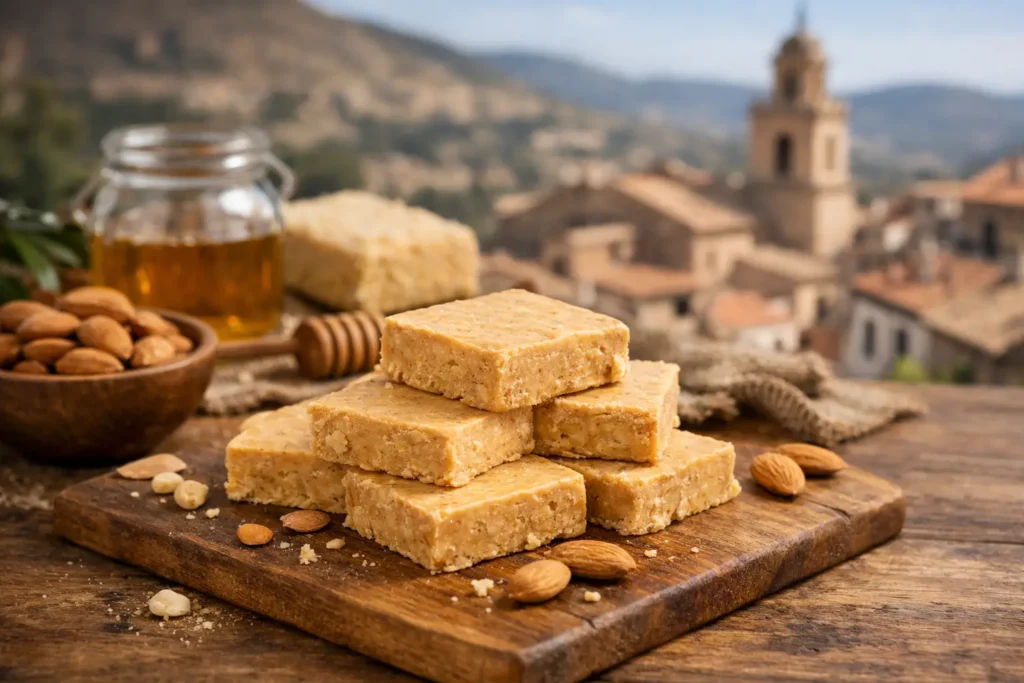
When a turrón bears the IGP Jijona designation, it is not a mere label detail. For lovers of origin-based products, this indication changes everything—the provenance, the method, the composition, and ultimately the trust you can place in what you are tasting.
In the world of Spanish sweets, many products look similar from a distance. But between a nougat inspired by the Spanish style and a genuine IGP Jijona turrón, the gap is real. Flavour, texture, selection of raw ingredients, production framework: the difference is felt from the very first bite.
IGP Jijona turrón: exact meaning
The phrase “meaning of IGP Jijona turrón” refers to a question that seems very simple: what exactly does this designation guarantee? IGP stands for Protected Geographical Indication. It is an official sign that protects a product linked to a specific geographical origin and recognised know-how.
In the case of Jijona turrón, this means the product must meet a strict set of specifications. It is not enough to evoke Spain, or even tradition. The turrón must be made in a defined area around Jijona, using regulated methods, with precise quality criteria.
In other words, IGP is not marketing. It is a guarantee of verified authenticity. For French consumers looking for a premium product, it is a clear reference point in a market where words like artisan, traditional or authentic are sometimes used too freely.
why Jijona is at the heart of true turrón
Jijona, or Xixona in Valencian, is a Spanish town in the province of Alicante. Its name has been closely tied to the history of turrón for centuries. It is no coincidence that this locality has become the absolute benchmark for this speciality.
The climate, almond cultivation, the passing down of techniques and the family roots of workshops have shaped a very distinctive gourmet identity. Here, turrón is not just one recipe among others. It is a living heritage.
To speak of Jijona is therefore to speak of a cradle. And in the case of an IGP, this link to place is not decorative. It underpins the product’s legitimacy. A turrón made elsewhere can be good. It can even be very good. But it cannot claim IGP Jijona if it does not respect this origin and the requirements that come with it.
what the IGP really guarantees on your plate
The first point concerns traceability. An IGP implies control of origin and the manufacturing process. This protects consumers against vague imitations or free interpretations of a prestigious product.
The second point relates to the recipe. Jijona turrón is known for its soft, melting, almost creamy texture, achieved through finely grinding the almonds and carefully cooking them with honey, sugar and egg white. This texture is one of its most recognisable signatures.
The third point is consistent quality. Not all turróns are equal, even within the same product family. The IGP sets a framework. It does not replace the maker’s talent, but it establishes a solid baseline. For a treat purchase—and even more so for a gift purchase—this reassurance matters.
If you would like to better understand the world of this speciality, you can also browse the Maria Simona shop, discover classic turróns, explore no-added-sugar turróns, or view gift boxes and packs.
Jijona turrón and Alicante turrón: beware of confusion
In France, people often confuse several turrón families under the same word. Yet Jijona turrón and Alicante turrón do not offer the same experience.
Jijona turrón is soft. The almonds are finely ground, creating a dense, supple and generous paste. Alicante turrón, by contrast, is hard and crunchy, with whole almonds set in a firmer structure.
Both belong to the great Spanish tradition and each benefits from recognition linked to its origin. But when one speaks of “Jijona”, one is indeed referring to that melting, elegant texture with a long finish, which makes turrón a tasting product rather than a simple sweet.
the raw ingredient, where everything is decided
The meaning of IGP Jijona turrón cannot be understood without talking about ingredients. A great turrón relies on few elements, leaving little room for approximation. When the recipe is short, every choice matters more.
Almond naturally plays the leading role. Its quality, variety, percentage in the recipe and how it is processed directly influence the final flavour. Next come honey, sugar and egg white. In a demanding house, there is no artifice to mask average raw ingredients.
This is also why consumers who pay attention to composition look closely at additional claims: palm-oil-free, gluten-free, natural ingredients, clearly stated origin. These elements do not replace the IGP, but they extend the same logic of high standards.
a label is not enough on its own
It must be said frankly: the IGP is a major reference point, but it does not tell the whole story. Two certified turróns can have different profiles depending on the level of ingredient selection, the house’s know-how, the finesse of small-batch work, or the desired flavour balance.
This is where taste takes precedence. Some turróns aim for a very rounded sweetness. Others seek a more pronounced almond intensity. Some favour a very smooth texture, others a more rustic presence.
For discerning consumers, the best approach is therefore to read the IGP as a foundation, not as an end in itself. It protects authenticity of origin. Excellence, however, is then determined by the maker’s choices.
why this designation matters so much for a gift purchase
Giving a premium turrón is not trivial. You are not only giving a sweet treat; you are giving an origin, a story, a way of welcoming. In this context, the IGP Jijona designation becomes particularly valuable.
First, it reassures. When putting together a gift for loved ones, clients or colleagues, you want to avoid a generic impression. A certified product, identified by its territory and carrying genuine know-how, has a much stronger perceived value.
It also conveys something more subtle. A well-chosen Jijona turrón evokes patience, Spanish tradition, and the taste of the real thing. It is a gift that speaks of quality without ostentation. For the holidays, a thank-you, or a corporate gesture, this nuance often makes the difference.
how to recognise a genuine IGP Jijona turrón
Practically speaking, first check for the explicit presence of the IGP Jijona designation on the product. Packaging that evokes Spain, almonds or a traditional recipe is not enough.
Next, look at the product’s identity. Jijona turrón should clearly state its soft nature and its firm roots in this specific tradition. If the messaging remains vague about origin, it is best to be cautious.
Finally, take the time to look at the overall positioning. A serious house readily talks about its ingredients, its production, its composition commitments and its fidelity to a real origin. When everything is clear, trust follows naturally.
meaning of IGP Jijona turrón: more than a label, a promise
Ultimately, the answer to the question “meaning of IGP Jijona turrón” comes down to one simple idea: this designation protects a product that belongs to a place, a method and a specific tradition. It guarantees that you are not facing a vague inspiration, but a turrón rooted in an authentic lineage.
For those who love genuine products, this distinction is not secondary. It allows you to choose more accurately, to better understand what you are paying for, and above all to find in the tasting what the label promises.
Then there remains what matters most—what no label can fully replace: the meeting of impeccable raw ingredients, patient know-how, and the pleasure of sharing a sweet treat with an origin, substance and soul.