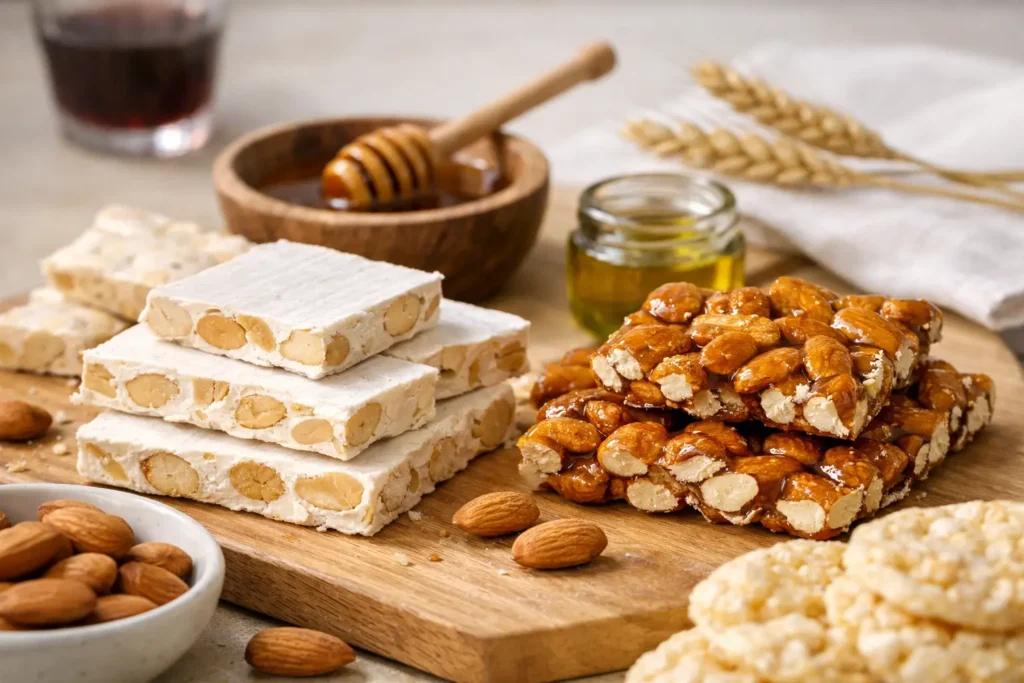
Offering a turron to someone on a gluten-free diet should never feel like a gamble. Yet, between industrial confectionery with endless ingredient lists and vague promises about origin, doubt quickly sets in. When looking for authentic gluten-free Spanish nougat, it is not just about avoiding an ingredient. It is also about rediscovering the precision of a flavor, the nobility of a raw material, and the confidence inspired by a well-made product.
The subject deserves more than a simple logo on a package. In turron, the question of being gluten-free concerns the composition, of course, but also the manufacturer’s level of standards, respect for traditional recipes, and the traceability of ingredients. This is where the difference is made.
What a gluten-free Spanish nougat really is
Traditional Spanish turron is based on a very simple foundation: almonds, honey, sugar, and egg white, depending on the recipe. In its most authentic expression, it requires no flour or superfluous texturizing agents. In other words, a gluten-free Spanish nougat is not an “adapted” version by default. It can simply be the most faithful form of this confectionery when crafted with rigor.
However, precision is necessary. The natural absence of gluten-containing ingredients is not always enough. What also matters is the mastery of manufacturing and the absence of cross-contamination. For a discerning enthusiast, or for someone following a strict diet, this nuance changes everything. A serious artisanal product is not content with just being delicious. It must be clear about what it contains and what it excludes.
Why all turrons are not created equal
On paper, many products seem similar. In the tasting, it is a different story. Some turrons rely on an artificially smooth texture, excessive sugar, or flavorings that mask a poor recipe. Others respect time, material, and balance.
When discussing gluten-free Spanish nougat, one must look beyond the health claim. The real question is: what is this turron made of, and where does it come from? A well-chosen almond does not just provide crunch or melt-in-the-mouth quality. It brings depth, length on the palate, and an identity. The honey, too, structures the whole. If either is replaced by lower-quality ingredients, the product loses its soul.
There is, therefore, a very simple trade-off. One can buy a convenient, standardized, merely acceptable confection. Or choose a turron that carries an origin, a craftsmanship, and a true gustatory promise. For a personal treat as well as for a gift, the second path rarely leaves one indifferent.
The importance of origin for a gluten-free Spanish nougat
The word “Spanish” should not be decorative. In the world of turron, origin is a decisive benchmark. It speaks of the terroir, the techniques, the transmitted recipes, and the expected level of excellence. A PGI Jijona turron, for example, is not marketing dressing. It is a guarantee of heritage and method.
This indication protects a recognized heritage. It frames the product, its manufacturing area, and the criteria that give it legitimacy. For the consumer, it is a very concrete way to distinguish an authentic Spanish-inspired turron from a confection produced far from this tradition.
In this search for accuracy, origin reassures as much as it elevates the experience. It allows one to know that they are buying a product that does not cheat on its history or its ingredients. If you wish to see this level of requirement applied to a specialized house, the selection available at https://www.mariasimona.com provides a clear interpretation, without unnecessary detours.
Ingredients to check before buying
A good turron hides nothing. Its ingredient list must remain legible. The longer it gets, the more caution is required. In a quality gluten-free Spanish nougat, almonds must play the leading role. They define the character of the product, whether it is a soft Jijona or a firmer, crunchier Alicante.
Honey is just as important. It does not simply serve to sweeten. It supports the structure, brings a more subtle sweetness, and contributes to the aromatic complexity. Egg white may be used in certain traditional recipes without raising gluten-related concerns. On the other hand, it is useful to be attentive to additives, syrups, added oils, or artificial fragrances that often signal a desire to compensate for what the raw material does not provide.
The absence of palm oil is also worth noting. It speaks to the integrity of the composition. A premium turron does not need fatty crutches to deliver on its promise.
What textures to expect from an authentic turron
Taste often begins with texture. This is particularly true for turron. Jijona offers a supple, melting, almost satiny texture, where the almond unfolds with roundness. Alicante, meanwhile, emphasizes the chew, the crunch, and the sharpness of the cut. Both can be naturally gluten-free, but they speak to the palate in different ways.
This point is far from anecdotal when purchasing. For a gift, the texture must match the occasion and the person. A lover of fine confectionery will often appreciate the depth of a Jijona. A guest who enjoys more straightforward and textured products will readily turn to an Alicante. There is no absolute right answer. There is, above all, an occasion, a preference, and a style of tasting.
To better compare styles and find the one that suits you, it may be useful to browse the online shop directly: https://www.mariasimona.com/boutique. The experience is clearer when categories are well-defined.
Gluten-free, but not pleasure-free
It still happens that “free-from” products are perceived as compromises. In the case of authentic turron, this idea does not hold. When the recipe is respected, being gluten-free diminishes nothing. On the contrary, it leaves full room for noble ingredients.
This is undoubtedly what makes gluten-free Spanish nougat particularly interesting for festive tables and gourmet gifts. It allows for the sharing of a refined confection with a wider circle, without giving the impression of a separate choice. The gesture remains generous, elegant, and deeply gourmet.
This dimension of sharing matters greatly. Turron is not just a product to be consumed. It is a sweet that is sliced, presented, and offered. In a house that handles gifts with care, formats designed to be given make perfect sense. You can see this spirit through the gift sets: https://www.mariasimona.com/collections/coffrets.
For gifting, a few benchmarks make the difference
When buying for oneself, one sometimes accepts a trial. When giving, one seeks certainty. The right benchmark is not necessarily the highest price. It is the alignment between origin, composition, aesthetics, and the promise of taste.
A well-designed gift set immediately brings this coherence. It showcases the product without overwhelming it. It values tradition without folklore. It also facilitates the choice when one wants to introduce several textures or recipes to someone who is not yet familiar with turron.
The discovery pack fits this logic perfectly, as it avoids having to decide too early between different expressions of the product. For a first purchase or a thank-you gift, it is often the most appropriate solution: https://www.mariasimona.com/products/pack-decouverte.
How to recognize a reputable house
A reliable brand speaks clearly about its ingredients, its origin, and its commitments. It does not wrap the essentials in an avalanche of slogans. It stands by what it does and what it does not do. No shortcuts in manufacturing. No artifices to mask a weak recipe.
In the world of gluten-free Spanish nougat, this sincerity is quickly apparent. It is seen in the prominence given to PGI Jijona, in the selection of raw materials, in the attention paid to compositions, and in the coherence of the range. A house that offers classic turrons, versions with no added sugar, and well-thought-out gift sets shows that it understands the real needs of its customers without compromising its standards.
One must also accept that a premium artisanal product does not follow the logic of mass-market goods. It will sometimes be more expensive than supermarket confectionery. But this difference does not just buy a more polished package. It pays for better-chosen ingredients, more precise craftsmanship, and a far more memorable tasting experience.
Good gluten-free Spanish nougat does not try to make you forget the absence of gluten. It serves, above all, as a reminder of what a great turron can be when given the time, the origin, and the materials necessary to speak truly.