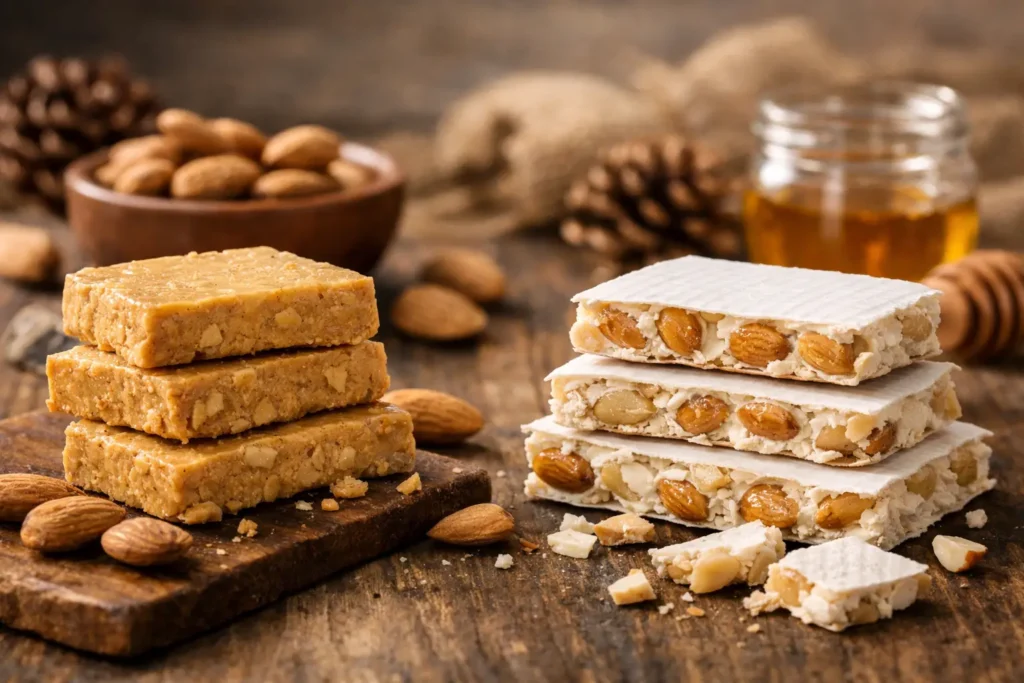
When offering authentic Spanish turrón, one question almost always arises: should you choose Jijona or Alicante? Both carry a history, a craftsmanship, and a commitment to quality. Yet on the palate, they deliver entirely different experiences.
One is smooth, almost creamy, with a texture that unfolds slowly. The other is crunchy, crisp, bright, with whole almonds that define the tasting from the very first bite. Understanding this difference means avoiding random purchases—and above all, choosing the turrón that truly matches the moment, the desired taste, and the person receiving it.
difference between Jijona and Alicante turrón: the simple answer
To get to the essentials, the difference between Jijona and Alicante turrón primarily lies in texture.
Jijona turrón is a soft turrón. It is made from roasted almonds that are finely ground, then mixed with honey, sugar, and egg white. This process yields a supple, smooth, dense, and aromatic paste.
Alicante turrón, on the other hand, is a hard turrón. Its base is similar in spirit—almonds, honey, sugar, egg white—but the almonds remain whole or in large pieces. The result is crunchier, more structured, with a very different bite.
In other words, you are not simply choosing between two recipes. You are choosing between two tasting experiences.
two specialties from the same heritage
Jijona and Alicante belong to the great tradition of Spanish turrón. They are not modern variations created to expand a catalog. They are two historic expressions of the same gourmet heritage, deeply connected to the province of Alicante and the culture of Mediterranean almonds.
This proximity explains why both feature noble, simple ingredients. But it is precisely the way the ingredients are worked that creates each turrón’s personality. In a demanding house, there are no shortcuts to compensate. Everything relies on the quality of the almonds, the precision of roasting, the balance of honey, and respect for time.
This is also why origin matters. When a turrón is certified PGI Jijona, we are not simply talking about geographic provenance. We are talking about a production framework, recognized craftsmanship, and a promise of consistency.
To better understand what makes these specialties unique, you can also consult the secrets of turrón, where you will find the production philosophy that distinguishes an artisan product from more standardized confectionery.
what truly changes on the palate
The most immediate difference between the two occurs the moment the turrón meets the palate.
Jijona turrón offers an enveloping sensation. The almond and honey paste, worked until fine and smooth, releases roasted, warm, almost buttery notes. There is an impression of depth, length, controlled sweetness. It is not a soft product in the ordinary sense. It is a dense, noble product whose texture carries the aromas.
Alicante turrón offers a more direct experience. The crunch of the whole almond, the tension of the sweet mass, the sharpness of the break give it a livelier character. You perceive more contrast between the elements. Where Jijona envelops, Alicante awakens.
Neither is superior to the other. Everything depends on the desired pleasure. If you enjoy smooth textures and flavors that linger, Jijona often stands out. If you prefer precision, crunch, and a more dynamic tasting, Alicante has a particular strength.
difference between Jijona and Alicante turrón: production and appearance
Visually, the two families are fairly easy to distinguish.
Jijona turrón has a golden-brown to deep beige color, sometimes slightly marbled depending on how the paste is worked. Its cut is uniform. It slices easily and offers a matte or satin surface. This appearance already hints at its smooth core.
Alicante turrón is lighter and more structured. The whole almonds are immediately visible. Its bar is often held between two thin wafer sheets. When cut, the appearance is clean, almost architectural. It is a turrón that shows its composition without pretense.
Production reflects this difference. In Jijona, grinding the almonds is central. The goal is to achieve a fineness that delivers the famous smoothness without losing aromatic intensity. In Alicante, it is the balance between the sweet mass and the whole almond that requires mastery. Too rigid, the turrón becomes harsh. Too soft, it loses its identity.
A good turrón is recognized precisely by this precision. It must be neither exaggerated nor approximate.
which to choose depending on the occasion
For a gift, the choice often depends on the recipient’s profile.
Jijona turrón appeals greatly to those who enjoy traditional products, generous textures, and refined sweets to share after a meal. It has something warm, almost familial, while remaining very elegant. It naturally finds its place on a festive table, with coffee or a glass of sweet wine.
Alicante turrón is well suited to those who enjoy bold flavors and the pleasure of crunch. It also works wonderfully in an assortment, as it brings relief and contrast.
If you are hesitant, the best answer is often not to decide too quickly. A discovery pack allows you to explore several expressions of turrón and compare without reducing this heritage to a simple opposition between soft and hard.
the importance of PGI and ingredients
For such an iconic product, quality is not judged solely by packaging or the displayed name. It is read in the origin, the selection of raw materials, and production transparency.
PGI Jijona certification guarantees a genuine connection to a terroir and tradition. For the discerning enthusiast, it is a valuable marker. It protects against diluted versions that are too sweet or disconnected from historic craftsmanship.
You must also examine the composition. Natural ingredients, quality almonds, the absence of palm oil, and a gluten-free recipe already say much about the house’s integrity. When a turrón is good, it does not need embellishment. It relies on few ingredients, but impeccable ones.
For those who wish to give pleasure without compromising certain dietary considerations, there are also turróns with no added sugar that respect the spirit of the product while meeting other expectations. Here again, a nuance must be accepted: the result will not be strictly identical to a classic recipe, but the point is precisely to preserve the taste of turrón in a different balance.
how to enjoy it properly
Jijona turrón deserves to be served at room temperature, in thin slices or small pieces. Too cold, it closes up. Properly tempered, it expresses all its roundness. It pairs very well with coffee, black tea, or a moment of sharing at the end of a meal.
Alicante turrón requires a slightly firmer cut. It is served in regular pieces to respect its structure. Its crunch is often sufficient on its own, but it works very well with an espresso or simply enjoyed plain.
In both cases, it is best to avoid distracted tasting. A good artisan turrón is not an anonymous treat. It is a specialty of character, meant to be tasted with attention.
If the idea is to give a gift, gift boxes truly make sense. They allow you to introduce several textures, several styles, and transform a delicacy into a tasting experience.
the real criterion: your relationship with pleasure
We often seek to know which is the best turrón. The question is appealing, but it is somewhat hasty. The best turrón is the one whose texture, intensity, and balance meet your taste—or that of the person you are offering it to.
Jijona captivates with its noble smoothness and depth. Alicante stands out with its boldness and crunch. Both deserve to be chosen for what they are, not for an artificial hierarchy.
At a house committed to 100% Spanish raw materials, PGI Jijona certification, and uncompromising craftsmanship, this difference becomes a richness. It allows you to compose a more precise, more personal pleasure, more faithful to the spirit of turrón.
The next time you hesitate between the two, do not simply look for a Spanish specialty. Look for the texture that will best express the moment you wish to share.