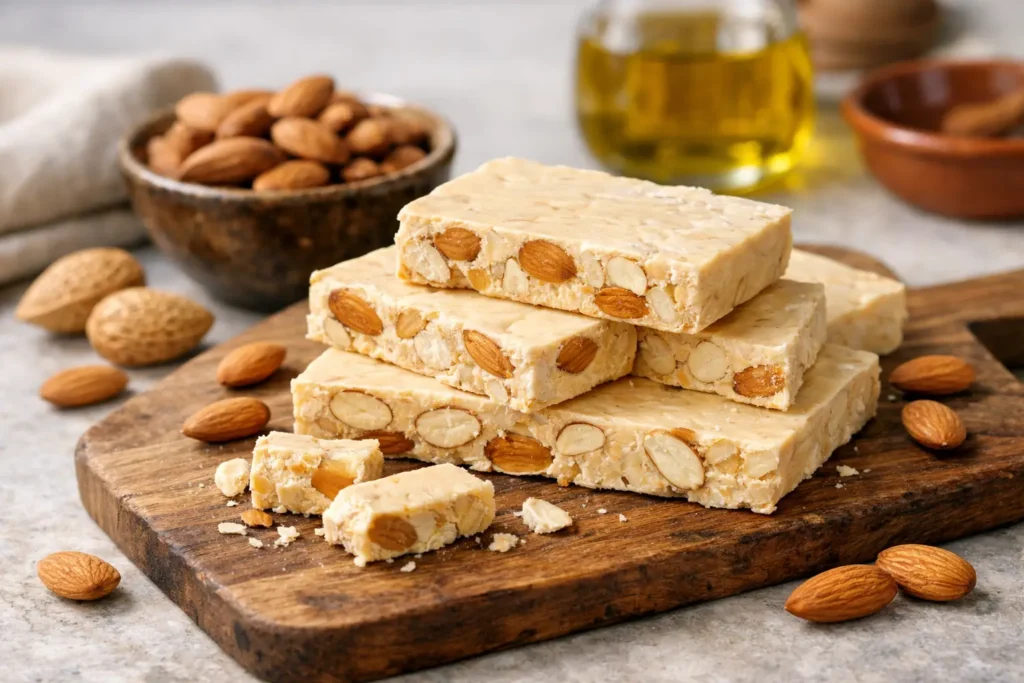
A clean cut into a good traditional Spanish almond turron is enough to understand that you are not dealing with a simple confection. The texture offers just the right resistance, the almond aroma emerges without excessive sweetness, followed by the depth of honey, a lingering finish, and a rich mouthfeel. These are the details that distinguish a festive-looking product from a true traditional turron, crafted with patience and a precise sense of origin.
For many connoisseurs, turron first brings to mind Christmas. However, reducing this product to a seasonal pleasure would be to overlook its true value. An authentic turron tells a story of its land, craftsmanship, and manufacturing choices that tolerate no approximation. When the almonds are Spanish, when the method respects the heritage of Jijona, and when the ingredients remain transparent, the taste takes on a new dimension.
Why Spanish Almonds Make All the Difference
In a quality turron, the almond is not just one ingredient among others; it is the heart of the product. Its variety, oil content, aromatic intensity, and even its reaction to roasting directly influence the final texture and balance of the product.
Spanish almonds are particularly sought after for this reason. They develop warmer, bolder, and often more persistent notes than standardized almonds from productions primarily focused on yield. In a soft turron, they provide noble fat and depth. In a firmer turron, they add texture, crunch, and that impression of generosity that lingers on the palate.
Consistency also matters. A Spanish turron made with 100% Spanish ingredients possesses a unity that is perceived without always being able to explain it. The honey, the almond, the cooking process—everything seems to speak the same language. It is this consistency that gives the product its elegance, far from overly sweet or artificially flavored recipes.
What Defines a True Traditional Spanish Almond Turron
The word “traditional” is often used lightly. In the case of turron, it should refer to concrete criteria. First, the selection of raw materials. Second, fidelity to ancient craftsmanship. Finally, the refusal of industrial shortcuts that add volume but remove soul.
A true traditional Spanish almond turron does not seek to mask quality with artifice. It does not need palm oil to hold together, nor an endless list of ingredients to create an impression of indulgence. It relies on few elements, but the right ones. This simplicity is demanding, as it leaves nothing to hide.
Slow cooking also matters. Too fast, it breaks the aromas. Too long, it hardens the material or unbalances the whole. The artisanal work consists precisely in achieving that perfect texture, one that respects the almond instead of crushing it under sugar.
Finally, a traditional turron is recognized by its personality. It is not smooth. It has a grain, a presence, sometimes even slight variations from one batch to another. This is the sign of a living production, made in small batches, with real attention paid to the product.
IGP Jijona, a Benchmark for Smart Purchasing
For a French connoisseur buying online, origin can quickly become blurred. Packaging speaks of tradition, visuals evoke Spain, but not all products are equal. This is where IGP Jijona plays a decisive role.
This Protected Geographical Indication (PGI) regulates the origin and production of certain emblematic turrons. It is not a marketing gimmick. It provides a serious guarantee of the link between the product, its territory, and its manufacturing method. When seeking a high-end turron, it is a reassuring, almost indispensable benchmark.
To better understand what distinguishes this designation, it may be useful to consult the page dedicated to IGP Jijona turron. It highlights what makes a product of origin legitimate, and why this certification remains so important for those who reject imitations.
This does not mean that the label alone does everything. The taste, the manufacturer’s touch, the quality of the almonds, and respect for time remain essential. But the IGP establishes a framework. It sets a level of expectation. In a world where authenticity is often claimed, it is a tangible difference.
Soft or Hard, a Matter of Taste – and Moment
When speaking of almond turron, many immediately think of hard turron, very rich in whole almonds. Others prefer the soft turron of Jijona, where the almond is ground to obtain a dense, supple, and intensely flavored paste. Both expressions have their nobility.
Hard turron captivates with its crispness. It breaks in the mouth, allowing the whole almond to express itself, and pairs very well with black coffee or a small serving of sweet wine. Soft turron, on the other hand, settles with more roundness. It is particularly suitable for those seeking a more enveloping, almost creamy, yet light tasting experience.
There is no absolute hierarchy between the two. It all depends on the palate, the context, and even the time of day. For gifting, varying textures is often the best idea. This is also what makes a discovery pack particularly interesting for a demanding first approach.
How to Recognize Truly Premium Quality
When purchasing, certain signs are unmistakable. The first is the clarity of the ingredients list. The shorter and clearer it is, the better. The second is the unambiguous origin of the ingredients. The third is the visual balance of the product itself. A good turron does not need to overdo it.
The mention of gluten-free and the absence of palm oil also matter to many consumers who are mindful of what they serve at their table. Here again, the challenge is not to follow a trend, but to remain faithful to a simple idea of quality. When the product is well-designed, it does not need to be corrected with filler ingredients.
Those who wish for a more measured indulgence can also opt for a sugar-free range. A slight compromise always exists in terms of texture and aromatic perception, as sugar contributes to the structure of a turron. But when well-crafted, this type of recipe allows one to retain the essence of pleasure without sacrificing personal dietary criteria.
Turron as a Gift of Taste
Offering artisan turron is not insignificant. It means choosing a gift that speaks of taste before it speaks of price. At a time when so many gifts seem interchangeable, a turron of origin asserts a more genuine intention. It evokes sharing, the table, and time spent together.
This choice takes on even more meaning in a professional setting. For a company, a Works Council (CSE), or an HR department, a well-composed gift box conveys an image of care and discernment. It’s not just about pleasing; it’s about showing refined, credible attention that is easy to give and appreciate.
The gift boxes precisely meet this expectation. They combine discovery, elegance, and authenticity in a ready-to-give format, without sacrificing product quality.
Savoring Traditional Spanish Almond Turron with Precision
The best way to serve premium turron remains the simplest. A stable room temperature, a clean cut, a simple plate. There’s no need to take it out of the refrigerator or present it with too many accompaniments. It can be paired with coffee, a low-tannin tea, or a discreet dessert wine, but the idea is never to mask its taste.
It also deserves to be savored slowly. A small piece is often enough to gauge its quality. With an authentic product, indulgence does not come from an immediate sugar rush. It arises from the aromatic persistence, the richness of the almond, and that rare sensation of having chosen something true.
To discover a selection faithful to this spirit, it is natural to visit the shop. There you will find what makes the value of an artisan Spanish turron when origin, ingredients, and taste are treated without compromise.
Ultimately, choosing a great turron means choosing a form of gourmet precision. Not excess. Not showmanship. Just the beauty of an ancient product, still capable of bringing people together around a table with quiet obviousness.