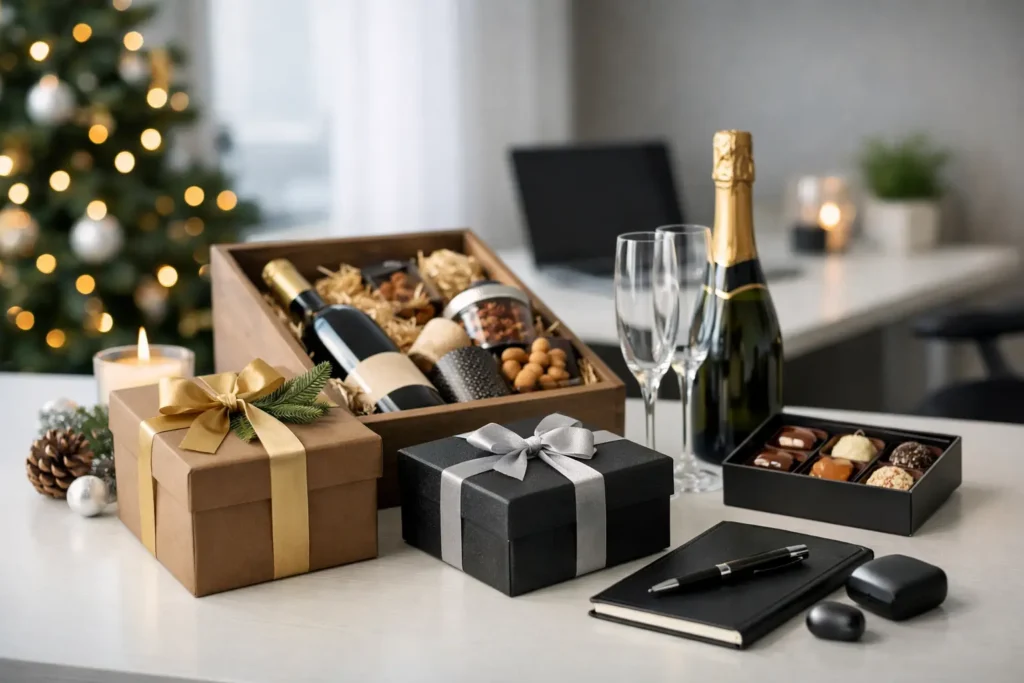
Giving a gift to a client in December is anything but an automatic gesture. It is often a very revealing moment. A good year-end client gift idea says something about your company without unnecessary talk—your attention to detail, your standards, your way of expressing thanks appropriately.
The problem is that many gifts fall into one of two categories that are quickly forgotten: the soulless promotional item or the overly predictable present chosen in a rush. Between the two, there is a better path: a gift that can be enjoyed, shared, leaves a real memory, and conveys genuine thoughtfulness. That is where premium gourmet gifts truly come into their own.
Which year-end client gift idea really makes an impression?
A good corporate gift does not need to be spectacular. Above all, it must be consistent. If you are targeting clients who value quality, provenance, and elegance, it is best to avoid gimmicky items that clutter a desk or end up in a drawer.
Gourmet products have one simple advantage: they create an immediate experience. You open it, you taste it, you share it. The gift truly comes to life. It does not remain a mere intention. At year-end, this warm dimension matters a great deal, because it naturally aligns with seasonal customs.
Still, you must choose a product that lives up to the occasion. A basic gourmet gift can have the opposite effect of what you intended. When you give on behalf of your company, every detail speaks—the origin, the ingredients, the presentation, the product’s sincerity.
Why premium gourmet gifts work so well as client gifts
In a business relationship, perceived quality is decisive. A well-designed gift box immediately conveys care. It does not need to be ostentatious to be memorable. On the contrary, the most appreciated gifts are often those that combine restraint, taste, and authenticity.
Artisan turrón fits this approach particularly well. It evokes celebration, sharing, and taking time for the good things. When it is made with selected ingredients, without palm oil, gluten-free, and according to recognized know-how, it becomes more than a seasonal treat. It becomes a sign of consideration.
For a corporate buyer, it is also a reassuring choice. It stays within a consensual, elegant, and accessible register, while avoiding the uniformity of gifts seen everywhere. The important thing is not only to give something good. It is to give something appropriate.
The criteria for a successful year-end client gift idea
The first criterion is universality. A client gift must suit a variety of profiles without seeming impersonal. High-end gourmet specialties meet this expectation well, provided you favor clear compositions and truly demanding craftsmanship.
The second criterion is perceived value. The goal is not to overdo it, but to avoid a gift that feels standardized. Fine ingredients, a carefully presented box, a clearly stated origin, an authentic recipe—these elements immediately change how the present is received.
The third criterion, often underestimated, is clarity. Your client should understand at a glance what they are receiving and why it was chosen. A certified artisan product, rooted in a specific tradition, is far more meaningful than a generic assortment with no real identity.
Finally, there is practicality. At year-end, purchasing, HR, or management teams look for reliable solutions that are presentable and easy to ship. A ready-to-gift box, with strong visual appeal and clear logistics, makes everything easier.
Giving a gourmet gift box: a more subtle gesture than a branded item
Many companies hesitate between personalization and discretion. Should you display your logo everywhere? Not necessarily. In premium client gifting, subtlety is often preferable to showmanship.
A well-chosen gourmet gift box leaves room for the recipient’s enjoyment. It does not turn the gift into an advertising medium. That is an important difference. The client does not receive a brand message disguised as a present. They receive genuine thoughtfulness.
That does not mean you must give up all personalization. A card, a note, or a format chosen to suit the relationship or the occasion may be enough. The right balance depends on the context. For a key account, you may opt for a more formal presentation. For regular partners, a warm and refined gift box will often be more appropriate.
Authenticity makes the difference
In the world of gourmet gifting, not all products are equal. What truly changes perception is proven authenticity. A traditional specialty backed by a real origin and identifiable know-how inspires more confidence than a standardized festive product.
IGP Jijona turrón, for example, has this rare strength: it tells a story of tradition without needing to overdo it. Its origin, its method, the selection of ingredients, and respect for time give the product a depth you can sense from the first taste.
For a year-end gift, this authenticity has a very concrete effect. It avoids the feeling of an interchangeable gift. It gives depth to the gesture. And in a client relationship, that depth matters more than one might think.
If you are looking for an offer designed specifically for the festive season and professional purchasing, it is worth consulting the gift boxes, created to be given elegantly, without compromising on quality.
How to choose based on the client profile
There is no single right answer. The right gift also depends on the relationship and the level of attention you wish to convey.
For loyal clients or strategic partners, a premium gift box is often the most appropriate format. It expresses consideration while remaining warm in tone. For larger mailings, a more understated yet still high-quality selection helps maintain coherence without trivializing the gesture.
You should also take dietary sensitivities into account. Today, offering a product with a clear composition is no longer a minor detail. It is a sign of seriousness. A house that offers recipes without palm oil, gluten-free, and a range dedicated to people watching their sugar intake shows that it understands current expectations.
On this point, the no-added-sugar turrón collection can meet specific needs without sacrificing pleasure or the elegance of the gift.
Avoiding the most frequent mistakes
The first mistake is buying too late. In a rush, you often choose an available product rather than a relevant one. The result: the gift ticks a box but creates no memory.
The second mistake is confusing price with impact. An expensive gift is not necessarily a good gift. What matters is the alignment between your image, the moment, and the real quality of what you give.
The third mistake, more subtle, is choosing a product with no story. At year-end, people receive a lot. To stand out, your gift must have presence. No need for a long speech, but it must have tangible distinctiveness—an origin, a texture, a taste, a house, a standard.
That is what makes artisan specialties more interesting than impersonal assortments. They already carry something to tell.
When the gift becomes an extension of your image
A client gift is never neutral. It acts as a silent version of your promise. If your company emphasizes care, reliability, and pride in work well done, then the present you send should extend that.
That is precisely why discerning houses attract so many companies at this time of year. A brand like Maria Simona, rooted in 100% Spanish artisan turrón and certified IGP Jijona, provides immediate proof of quality: a clear origin, selected ingredients, family know-how, and an aesthetic that is ready to gift.
To discover the full range, you may visit the shop or choose a more introductory format with the discovery pack, particularly suitable when you wish to offer a tasting experience.
This type of gift works well because it does not try to impress artificially. It relies on something more solid: taste, sincerity, and the lasting memory it leaves.
Ultimately, the best idea is not the one that makes the most noise. It is the one that gives your client the rare feeling of having received something chosen with care, rather than simply sent out of habit.