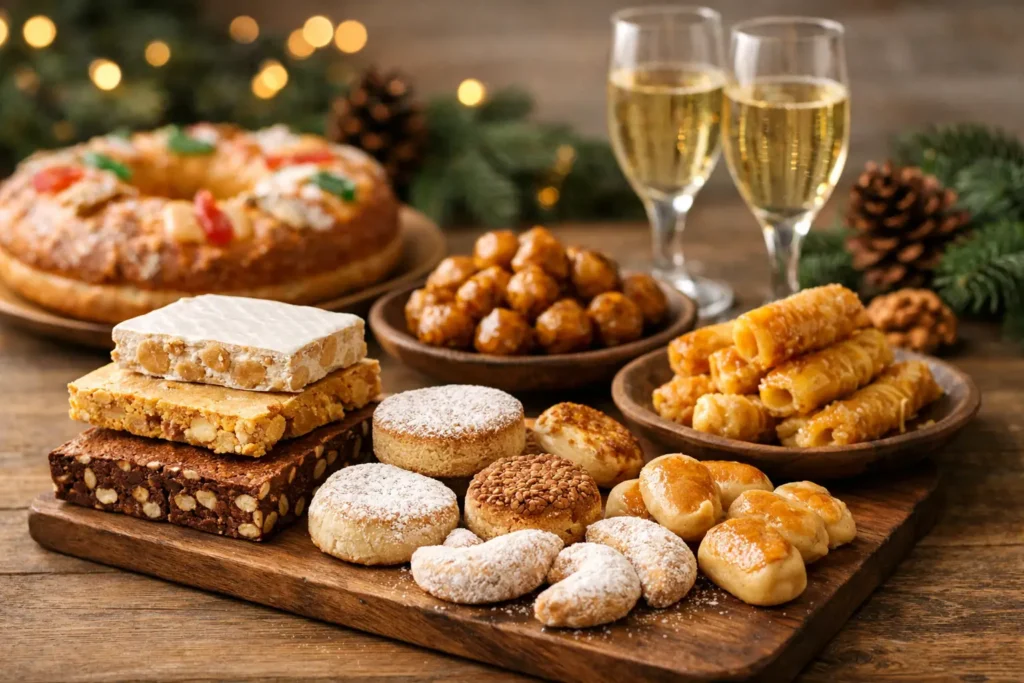
At Christmas, sometimes just one bite is enough to transport a table into another realm. In Spain, the typical Spanish Christmas dessert is not merely a sweet ending. It is a ritual of sharing, a family memory, a very tangible way of saying that one has chosen authenticity over mere embellishment.
From a French perspective, one often thinks of a single grand “festive dessert.” Spanish tradition tells a different story. On the Christmas table, several sweets coexist, complement each other, and form a much more subtle gourmet landscape. Among them, turrón holds a special place. Not because it is the most well-known, but because it encapsulates the essentials: origin, craftsmanship, time, and the quality of raw ingredients.
The Typical Spanish Christmas Dessert Is Not Always What You Expect
If you ask a Spaniard what the quintessential Christmas dessert is, they will not necessarily give a single name. Depending on the region, family customs, and the specific holiday moment, several specialties come into play. Turrón is the great classic of December gatherings. Polvorón, crumbly and buttery in the mouth, often accompanies coffee. Mantecado naturally finds its place on sweet platters. And the Roscón de Reyes belongs more to Epiphany than to Christmas Eve.
This nuance matters. To seek a typical Spanish Christmas dessert is to seek less a single item than a living tradition. But in this constellation, turrón remains the strongest reference. It spans generations, is given as gifts, shared, and immediately recognized. It is also the product where the difference between demanding craftsmanship and an industrial version is most distinctly tasted.
Why Turrón Remains the Signature of Spanish Festivities
Turrón is not just an ancient confection. It is a product of culture. In its noblest version, it relies on few ingredients, but on impeccable ones: almonds, honey, sometimes egg white, and above all, a savoir-faire that rejects shortcuts. When the origin is respected, the tasting has a particular depth. The taste is frank, the texture precise, and the finish elegant.
Two main families dominate. Turrón de Jijona, soft and melting, develops an almost creamy texture, driven by ground almonds. Turrón de Alicante, firmer, allows for more chewing and the crunch of dried fruits to express themselves. Both tell the story of Christmas in their own way. One reassures and envelops. The other asserts a clearer structure.
This is also why the IGP Jijona changes everything. It is not merely a label argument. It protects a savoir-faire, a provenance, and a level of excellence. For a French connoisseur who wants to offer or serve a true Spanish Christmas dessert, this indication is a valuable benchmark. It avoids approximations and places taste where it should be: in the product itself.
To better understand this tradition, you can consult the page dedicated to artisan turron, where you will find the house’s great classics.
Other Christmas Sweets in Spain
However, reducing Spanish festivities to turrón alone would be incomplete. Polvorón, for example, has a very different identity. More powdery, more shortbread-like, it breaks almost before melting. Its charm lies in this fragility. It is very popular, but it also divides opinions more. Some see it as an incomparable childhood memory, while others find it drier.
Mantecado, similar in spirit, offers a more compact texture. It pairs well with black coffee or a light end to a meal. As for mazapanes, they appeal to almond lovers in a softer, more pastry-like expression. Again, everything depends on the moment and individual palates.
The Roscón de Reyes deserves a separate mention. Often cited among Spanish Christmas desserts, it primarily belongs to January 6th. Its brioche-like crumb, decorated crown, and festive dimension make it a must-have for the broader holiday season, but less so for Christmas dinner itself.
In other words, if you are looking for the most emblematic sweet for Christmas Eve or a gourmet gift, turrón remains a step ahead. If you are looking to recreate an entire Spanish ambiance, then the ideal is to compose an assortment.
How to Recognize a True Spanish Festive Dessert
In the world of Christmas sweets, appearances can be deceiving. Packaging can easily evoke tradition. Taste, however, does not lie for long. A truly high-end product is first recognized by its composition. Clear, few ingredients, without unnecessary artificiality. A central place given to almonds. A texture that does not try to mask the raw material with an excess of sugar or flavors.
One must also consider the origin. Not all turrones are equal, and this is particularly true when comparing certified artisan production with standardized manufacturing. A company that works in small batches, with 100% Spanish ingredients, without palm oil and gluten-free, does not just promise a better product sheet. It offers a fairer, clearer, more consistent experience with what Christmas represents.
If you wish to offer this authenticity, gift boxes allow you to combine several tasting profiles without compromising on the demand for origin.
Which Typical Spanish Christmas Dessert to Choose Based on Use
For a family table, Jijona turrón often works better than expected. Its tender texture appeals to multiple generations, including those unfamiliar with Spanish specialties. It is easily served in thin slices and finds its place both at the end of a meal and with coffee.
For a gift, everything depends on the message one wishes to convey. A classic turrón certified IGP Jijona expresses a reliable, elegant, timeless gesture. An assortment allows for more surprise. In a professional context, this logic is even more important. A well-chosen box speaks volumes about the giver’s level of discernment.
For those mindful of their sugar intake, there is another path, provided it remains true to taste. A well-designed sugar-free range should never give the impression of a sad compromise. It must preserve the indulgence, texture, and pleasure of sharing. You can view the selection of sugar-free turrons if this expectation is part of your search.
The Art of Serving Turrón at Christmas
Turrón deserves more than a quick unwrapping between courses. To reveal its texture and aromas, it benefits from being served at room temperature, carefully sliced, on a simple platter. A good turrón does not need excessive staging. A few neat slices, a coffee, sometimes a glass of sweet wine or a low-tannin tea, and everything is already there.
The pairing depends on the variety chosen. Jijona calls for sweetness and roundness. Alicante better supports a slightly sharper contrast. If you are composing a complete end to a meal, it is ideal to avoid an accumulation of overly rich desserts. Turrón takes its full place when given space.
For those who wish to discover several textures before giving or receiving, the discovery pack is a simple way to compare without error.
More Than a Dessert, a Certain Idea of Sharing
What makes the Spanish Christmas dessert so powerful is not just its recipe. It is its function. It passes from hand to hand. It stays on the table. One returns to it informally, throughout the evening, from one conversation to another. It does not seek the spectacular effect of a restaurant entremet. It establishes something else: continuity, warmth, a fidelity to taste.
This is precisely why turrón retains such a unique place. It connects immediate pleasure to a longer history, made of transmitted gestures, respected raw materials, and a true sense of origin. In a market saturated with decorative promises, this demanding simplicity becomes rare.
At Maria Simona, this fidelity to gourmet Spain takes the form of a clear commitment: 100% Spanish turrons, certified IGP Jijona, crafted without artifice and designed to be given as gifts and enjoyed with the same obvious quality.
If you are looking for a typical Spanish Christmas dessert this year, choose the one that lets the product speak before the decor. That is often where the true taste of the holidays begins.